A working forecast
The long view
Humans are not the only animals that think, but we are the only ones that stack: we make tools, find uses their makers never imagined, and pass the whole lot on so the next generation starts where the last one stopped. This page is that story, from flaked stone to dated forecasts, with the scroll squashed logarithmically: sixty thousand years fits in one screen at the top, and a few months take the same space by the bottom. Scroll at a steady speed and feel the rate of change accelerate.
About 3.3 million years ago
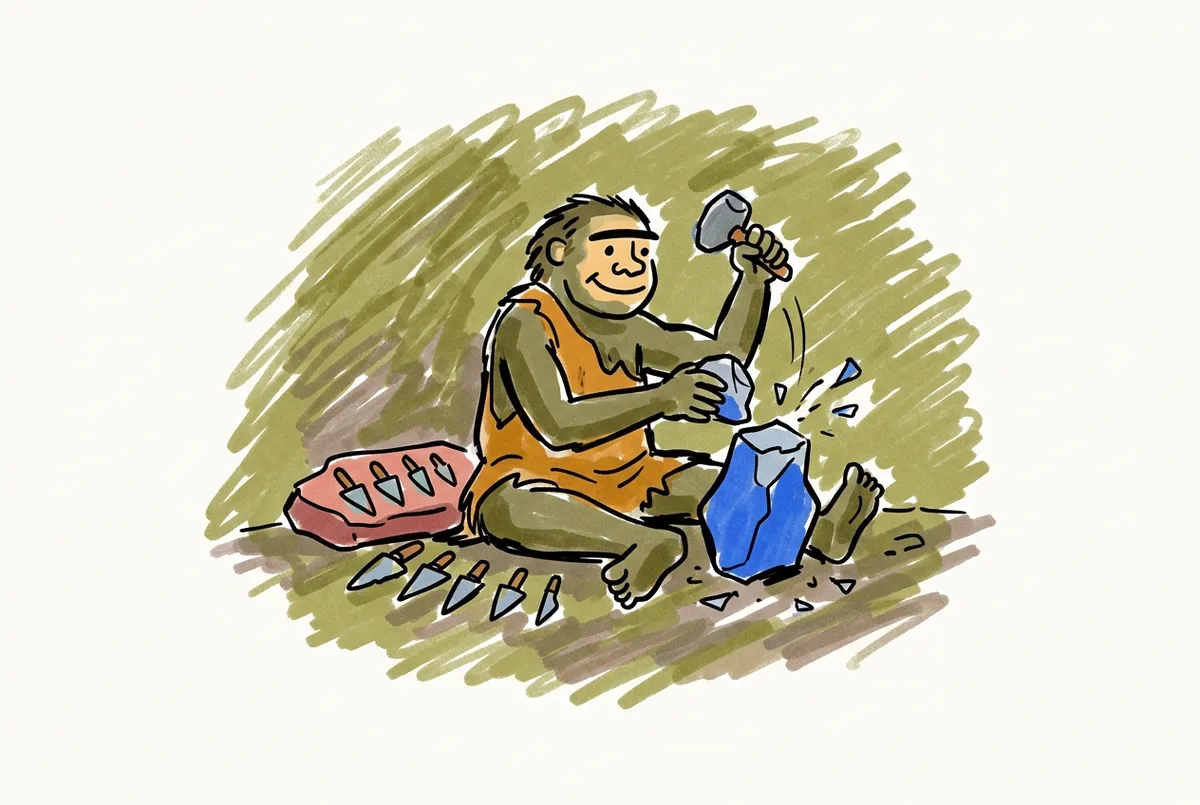
Stone tools
The first objects made to make other things: flaked stone for cutting and scraping, from before our genus existed. Capability starts living outside the body.
Source: Nature, the Lomekwi 3 tools
About 1 million years ago
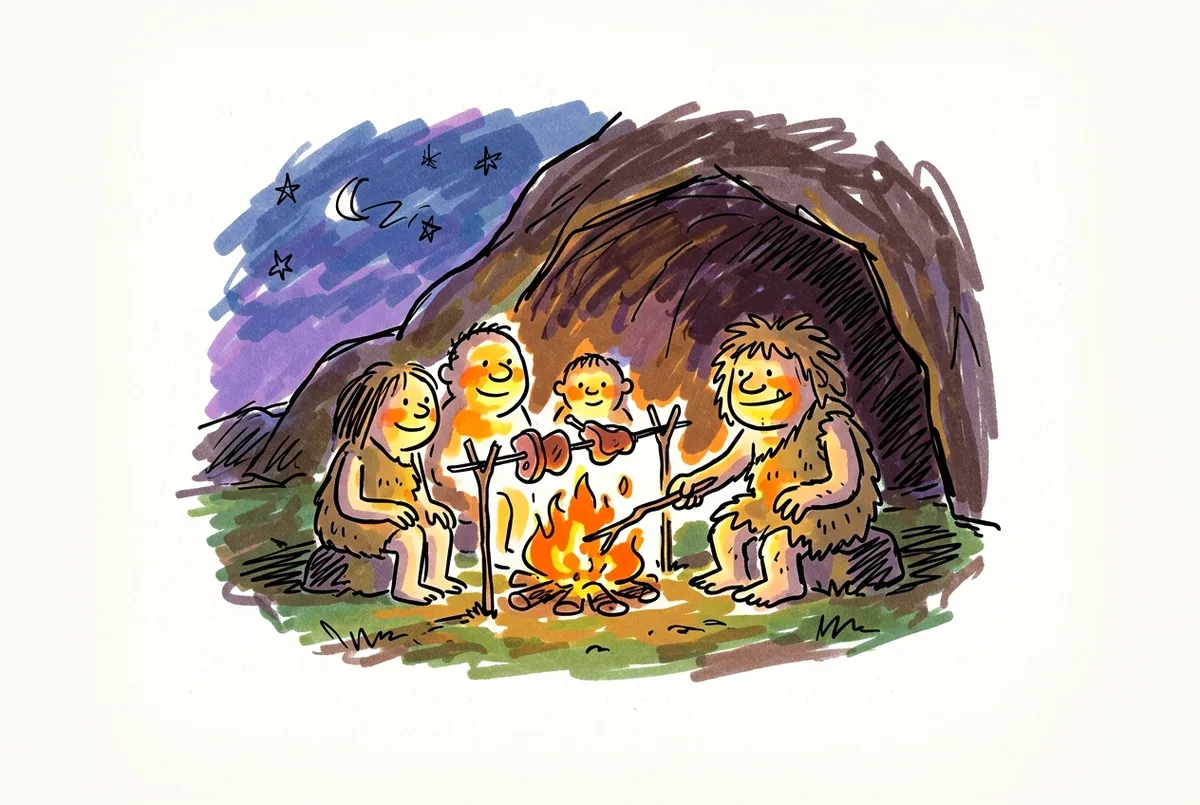
Control of fire
Cooking, warmth, protection, and more calories from the same food, which helped feed bigger brains. The first energy source anyone controlled beyond their own muscles.
Source: Control of fire by early humans
About 100,000 years ago
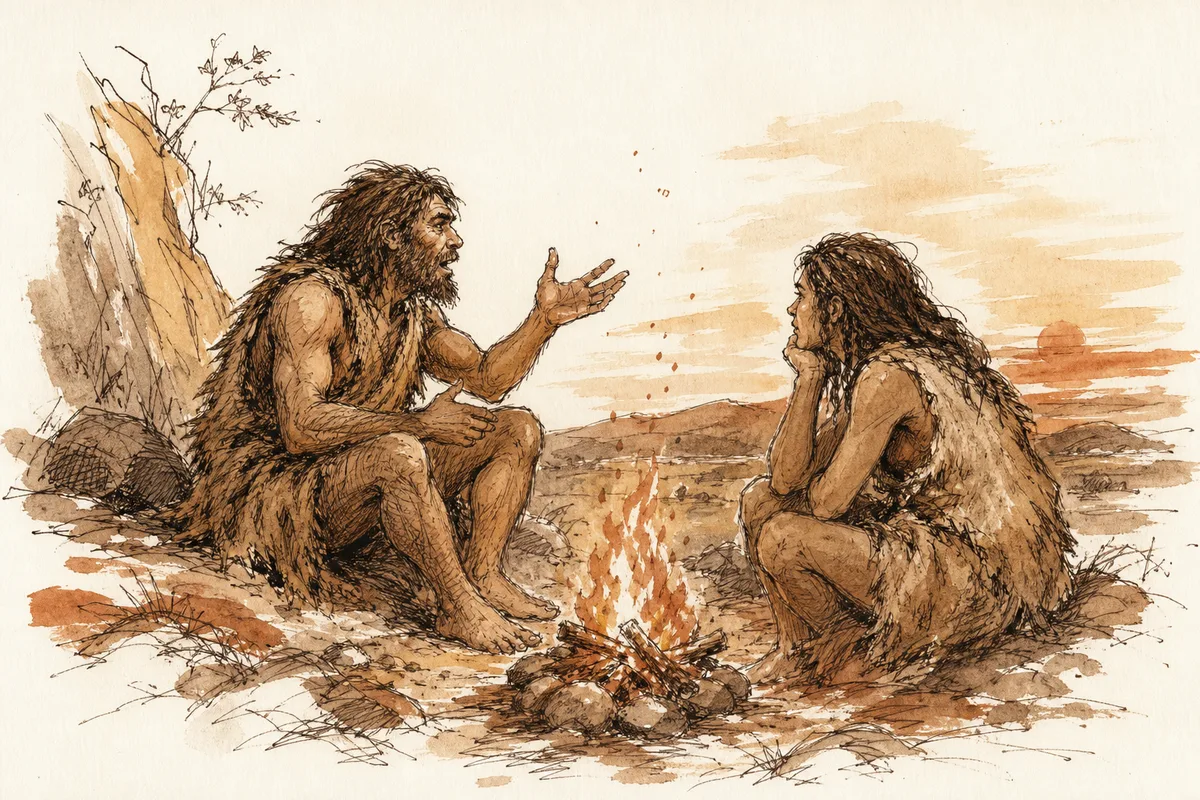
Language
Humans start talking. The date is contested by tens of thousands of years, but somewhere around here intelligence stops being trapped inside one skull at a time.
About 51,000 years ago
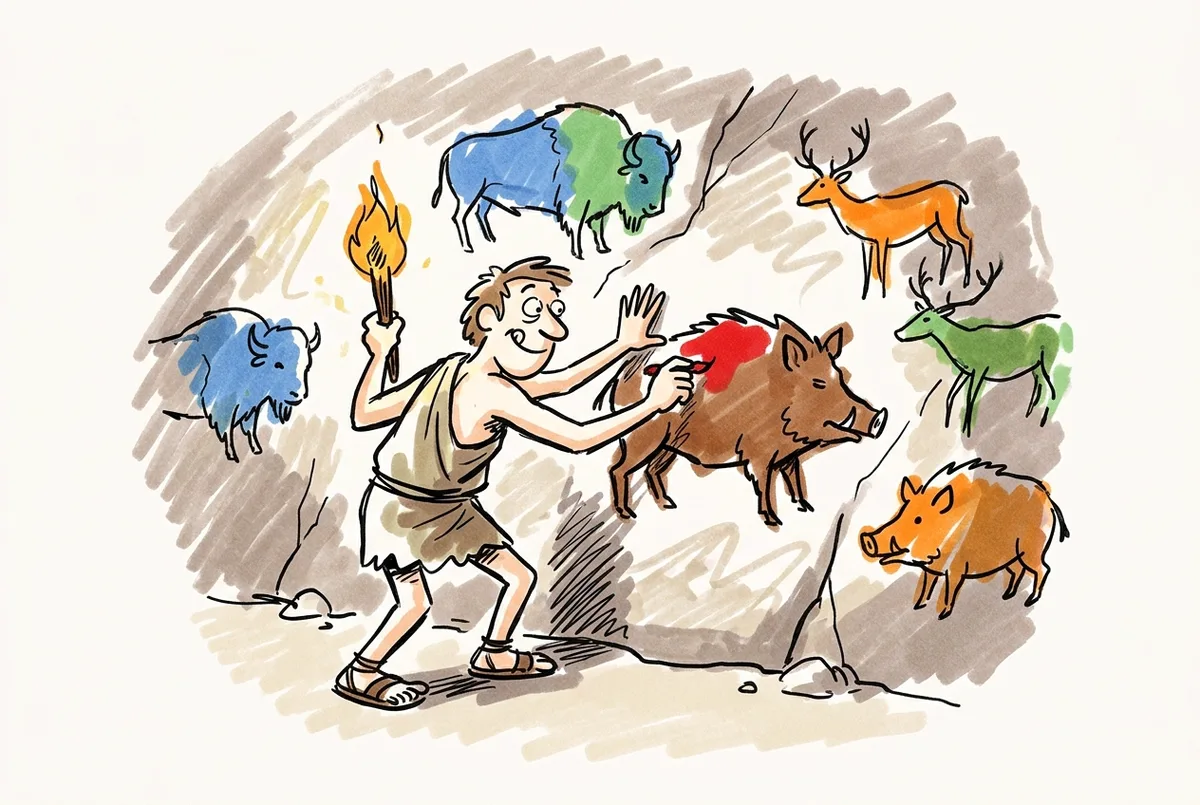
Symbols
The oldest known figurative art, a hunting scene painted on a cave wall in Sulawesi, was redated in 2024 to at least 51,200 years old. Minds start leaving durable copies of their contents where other minds can find them.
Source: Nature, 2024 redating
About 12,000 years ago
Agriculture
Farming produces surplus, surplus produces settlements, and settlements produce people whose whole job is thinking. Intelligence gets its first infrastructure.
Source: The Neolithic Revolution


Around 3200 BCE
Writing
Sumerian accountants press marks into clay and thought becomes storable, copyable, and transmissible to people not yet born. The first external memory.
Source: Cuneiform
Around 3100 BCE
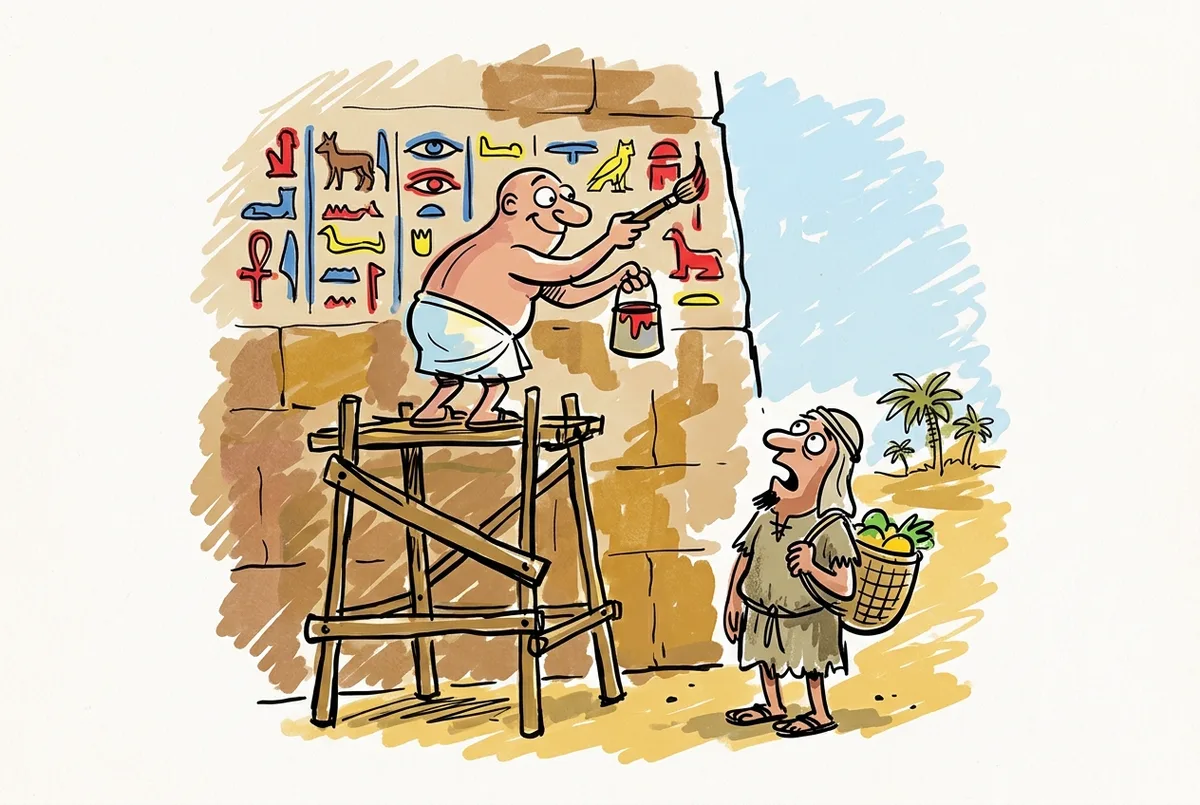
Hieroglyphs
Egypt develops its own script within a century or two of Sumer. Writing stays a specialist trade for millennia: scribes are a small literate class, and for the average person text means tax records and temple walls, read to you by someone else.
Source: Egyptian hieroglyphs
Around 350 BCE
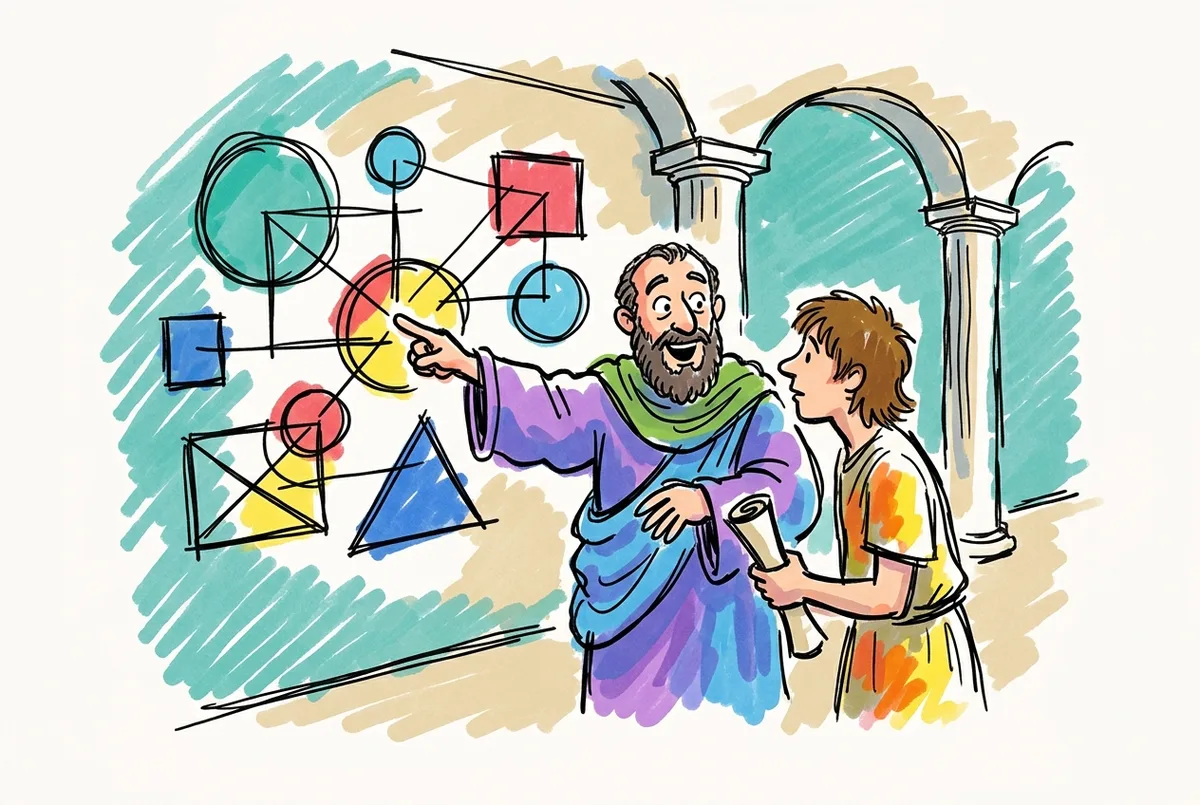
Formal logic
Aristotle writes down rules for valid reasoning, separate from what is being reasoned about. The idea that thinking has mechanics you could specify sits mostly idle for two thousand years.
Source: Stanford Encyclopedia of Philosophy on Aristotle's logic
Around 285 BCE
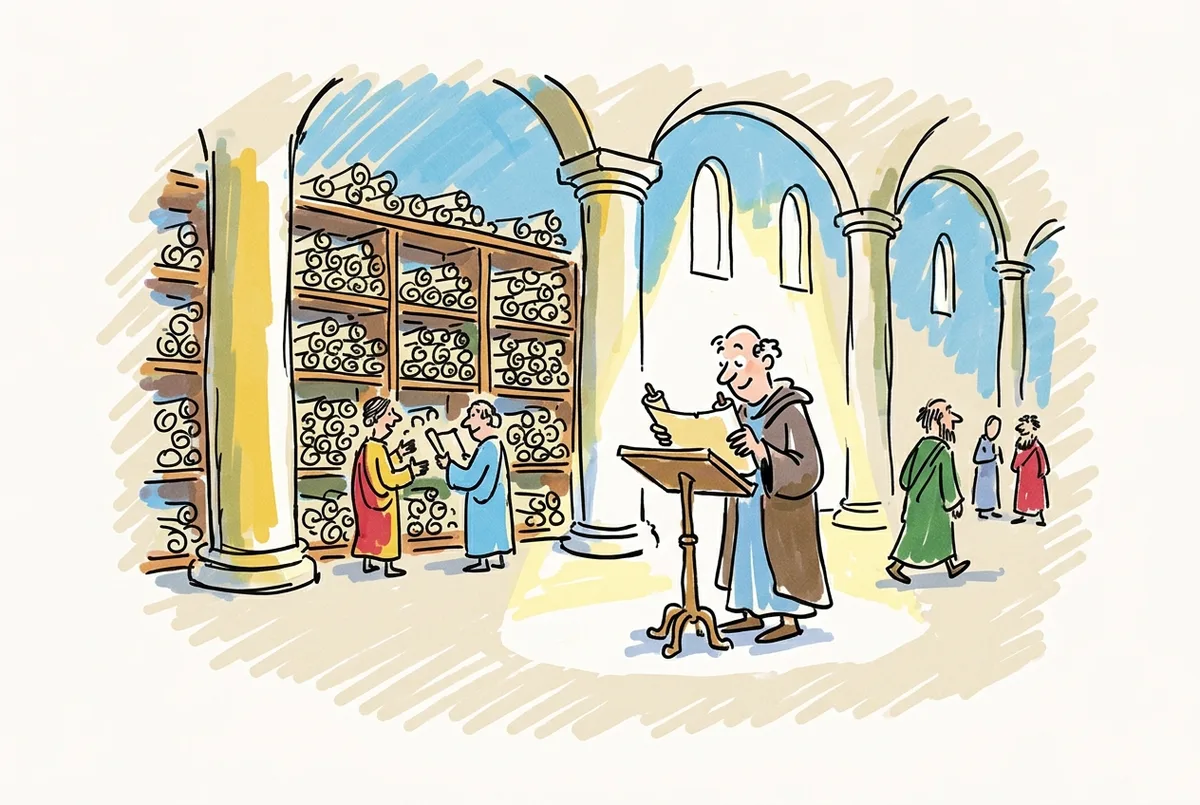
The Library of Alexandria
The Ptolemies try to put every text in existence in one building, hundreds of thousands of hand-copied scrolls. Centralising knowledge is the only option when each copy costs weeks of skilled labour, and it makes knowledge fragile: lose the building, lose the civilisation’s memory.
Source: Library of Alexandria
Around AD 800
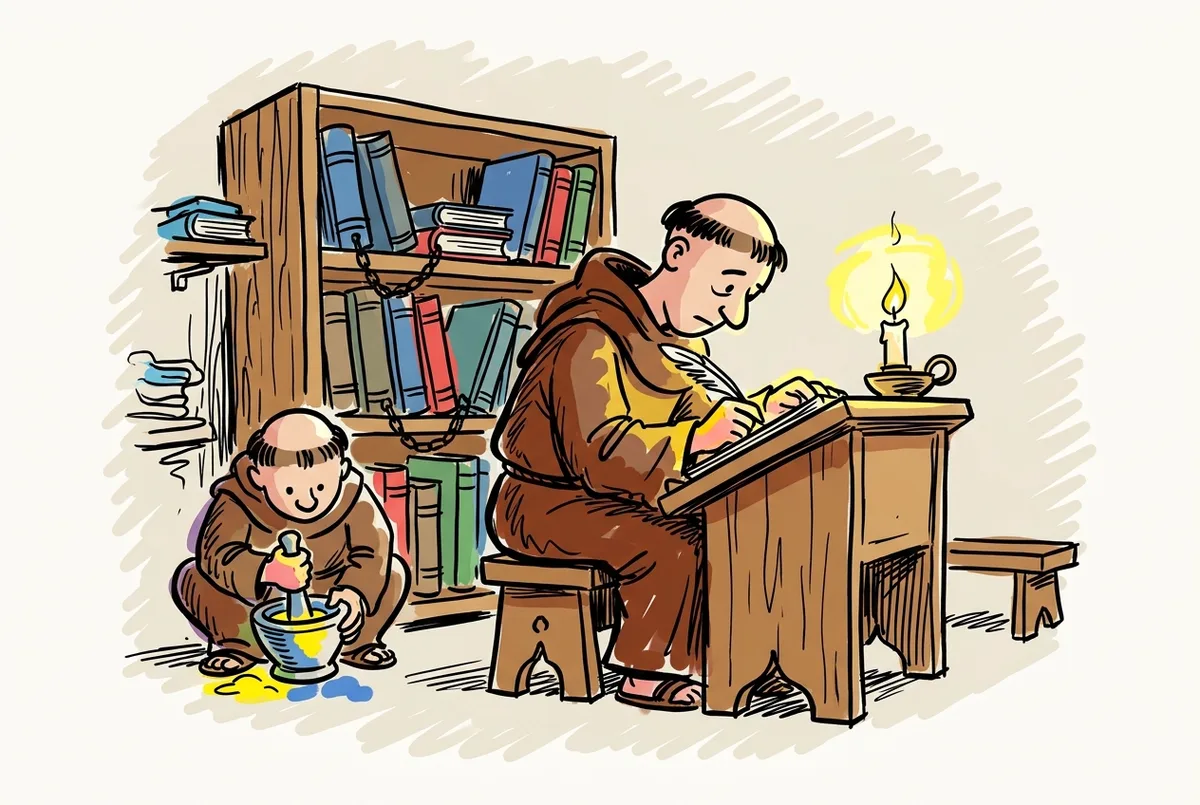
Copying by hand
For most of a millennium European books are reproduced one at a time by monks in monastery scriptoria, mostly religious texts. A single bible takes a scribe years and costs as much as a farmhouse. The average person never owns a book, never learns to read, and encounters text as something read aloud in church.
Source: Scriptorium
1440s
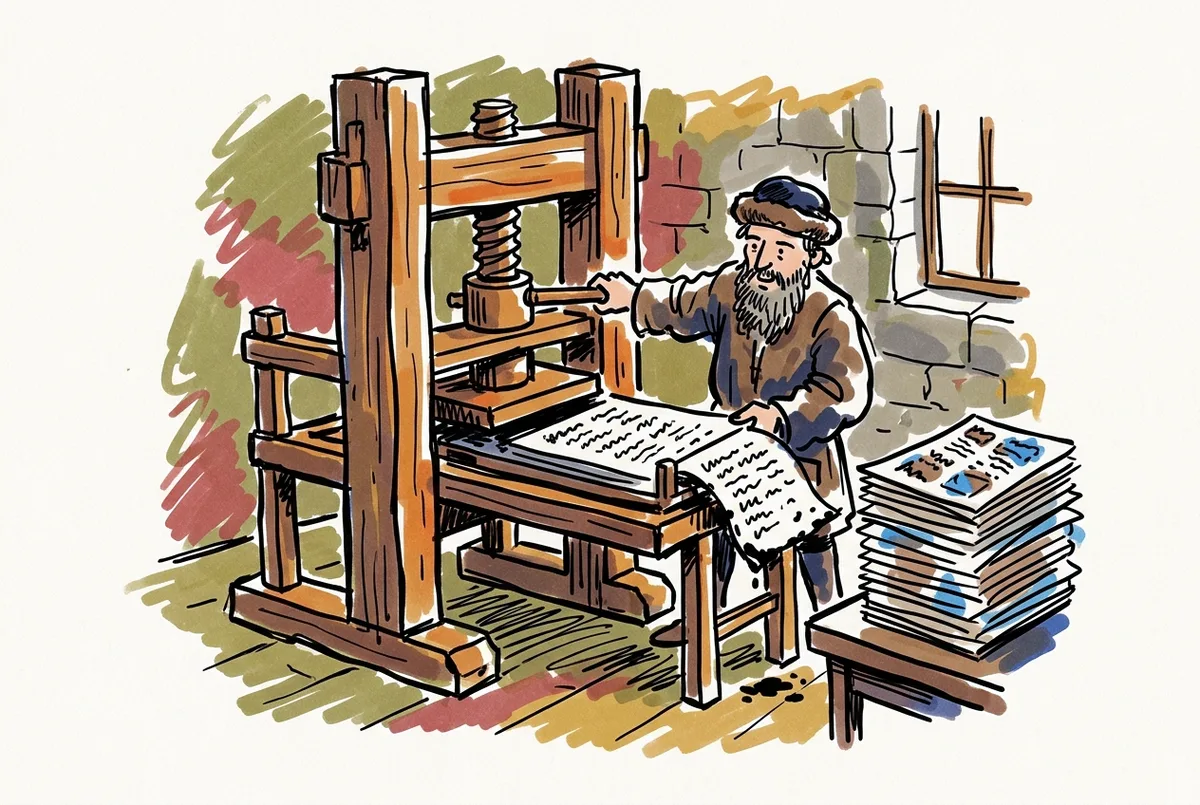
The printing press
Gutenberg makes copying thought cheap. Literacy, science, and reformation follow. Every jump on this page is some version of the same event: the cost of moving intelligence around falls off a cliff.
Source: The printing press
1770s
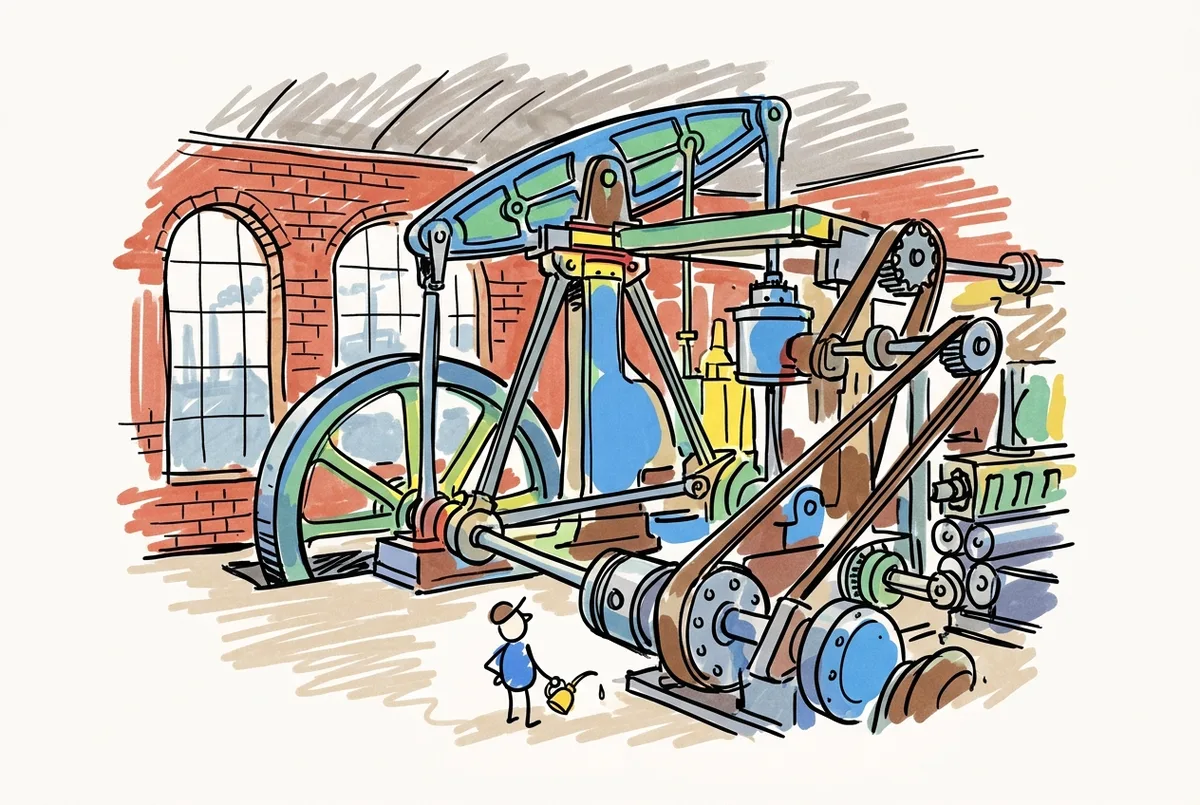
Steam power
Watt’s engine makes work independent of muscle, wind, and water. The Industrial Revolution runs on it, and for the average person the next century moves work from field to factory.
Source: the Watt steam engine
1843
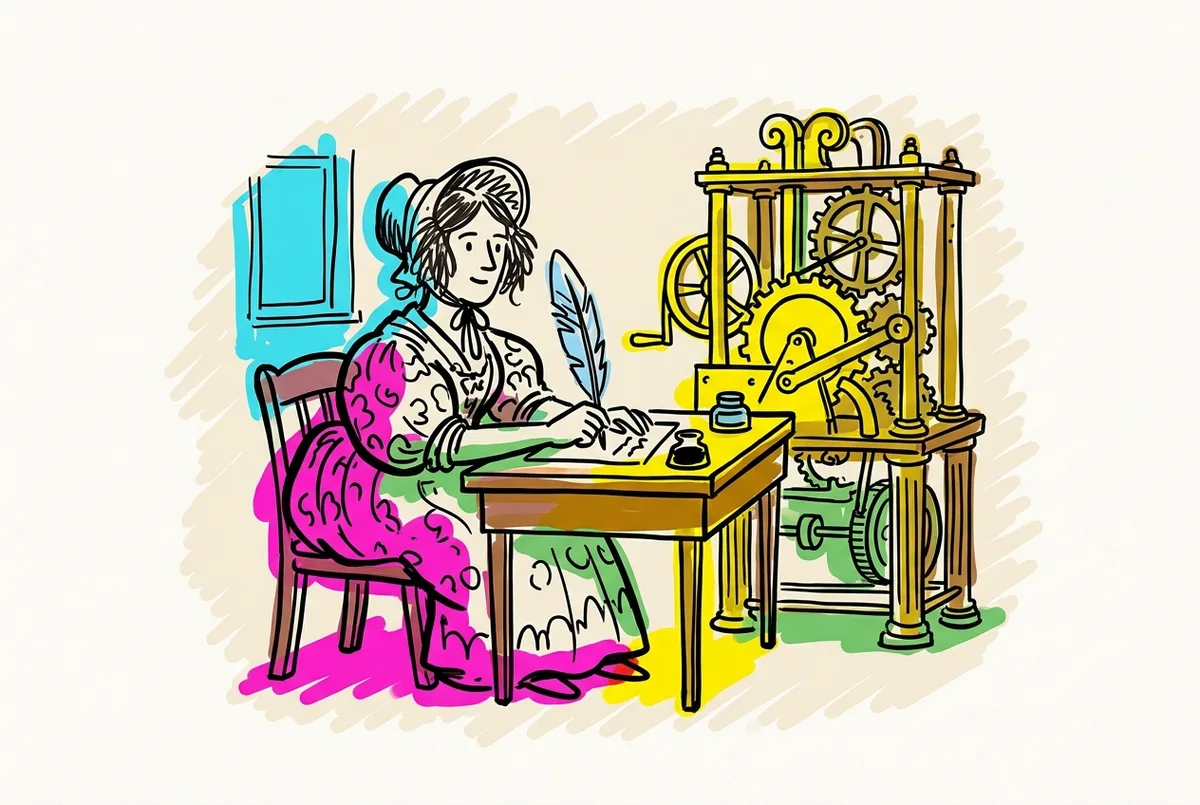
The first program
Ada Lovelace publishes Note G, an algorithm for a machine that had not been built, and observes that such a machine could manipulate symbols in general, not just numbers. Software precedes hardware by a century.
Source: Note G
1880s
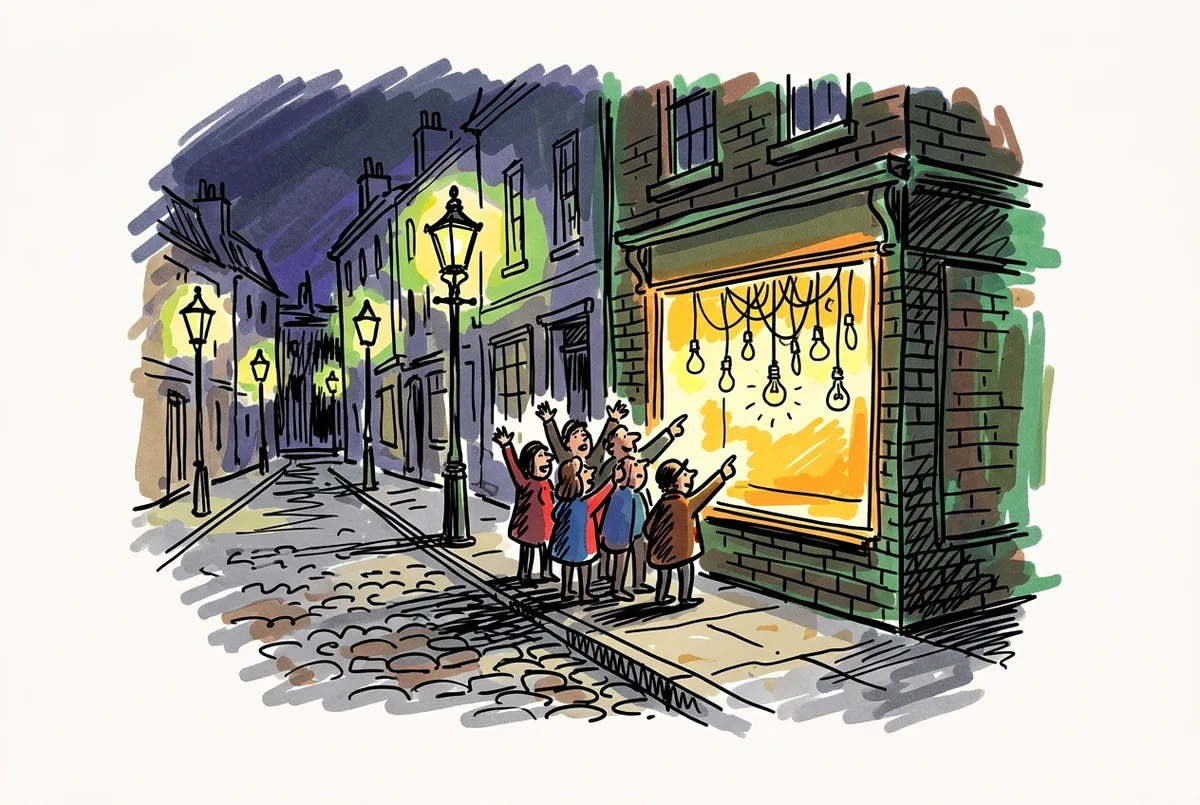
Practical electricity
Edison’s Pearl Street station starts selling power. Light, motors, and eventually every appliance decouple from fires and waterwheels; energy becomes something delivered to wherever the work is.
Source: Pearl Street Station
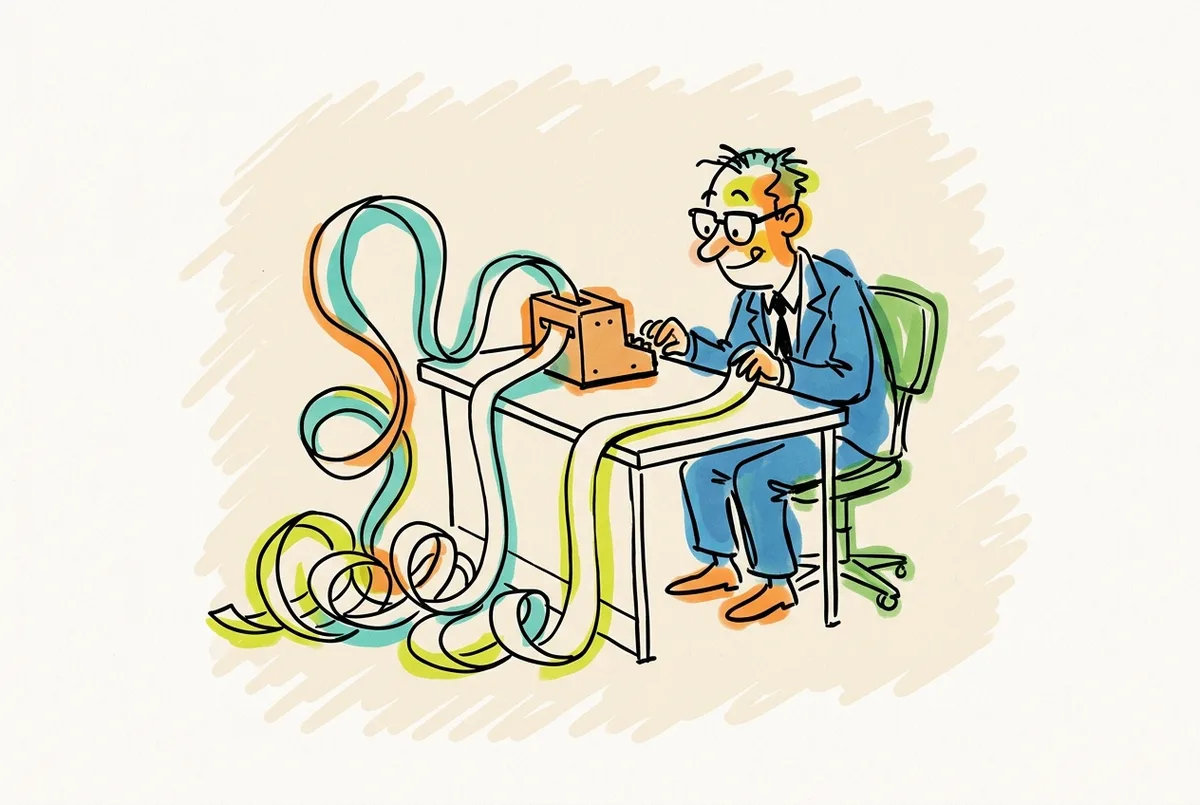
1936
The universal machine
Turing shows that one sufficiently simple machine can compute anything any machine can compute. The question quietly changes from "can a machine do X" to "what should we have it do".
1950
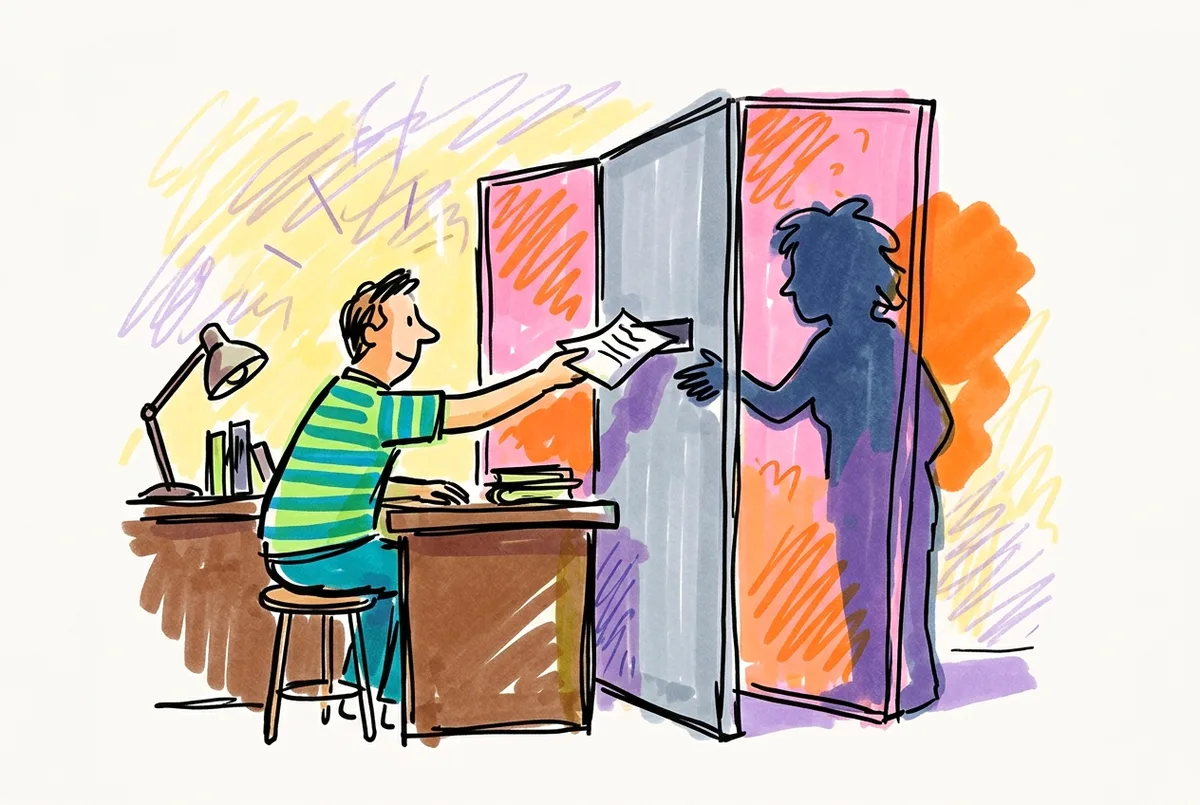
Can machines think?
Turing proposes sidestepping the philosophy: if you cannot tell the machine from the person in conversation, the distinction is not doing any work. The test outlives him by decades and then, oddly, gets passed almost without ceremony.
Source: Computing Machinery and Intelligence, the original paper
1956
"Artificial intelligence"
The Dartmouth workshop names the field and predicts significant progress in a summer. The summer runs long.
Source: the 1955 Dartmouth proposal (PDF)
1970s and 80s
The winters
Twice, funding and faith collapse when promises outrun hardware. Worth remembering when reading the bottom of this page: the field has been confidently wrong about its own speed in both directions.
Source: AI winter
May 1997
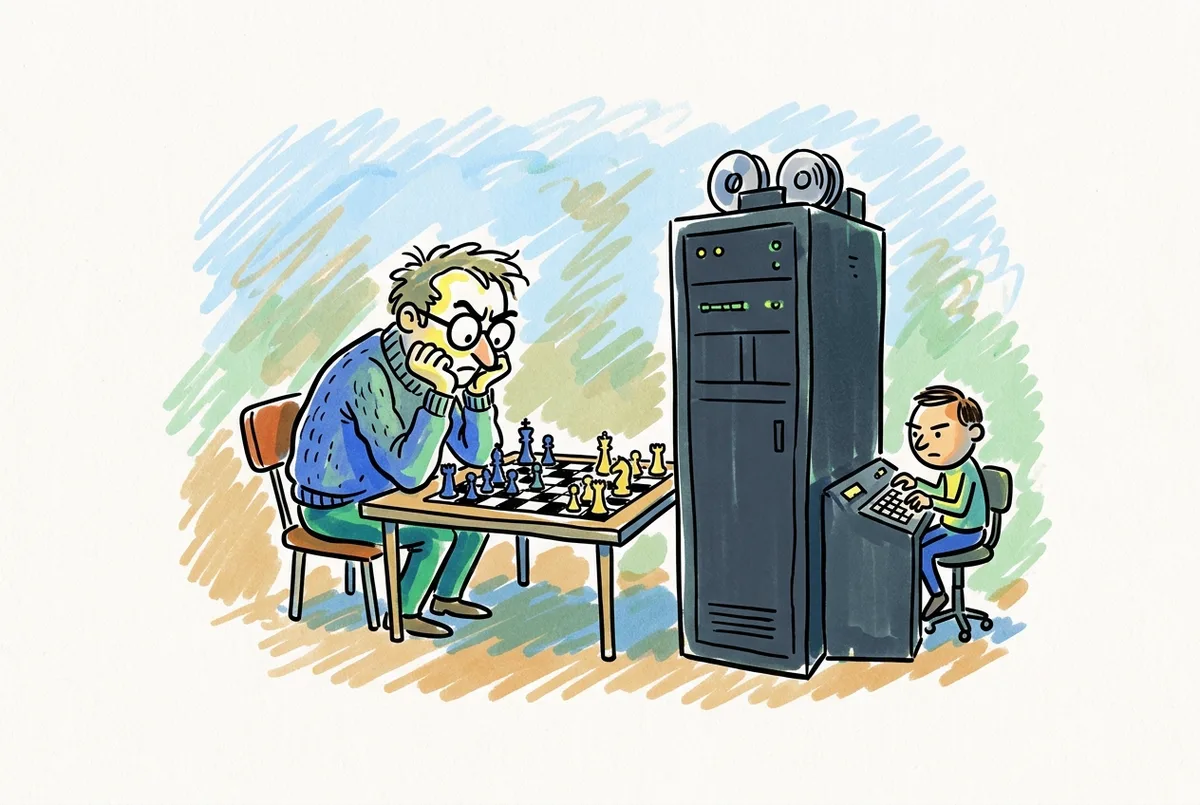
Deep Blue beats Kasparov
Chess falls to search and speed rather than understanding, and the goalposts move for the first time in public: fine, chess was never really intelligence anyway.
Source: IBM's Deep Blue history
Around 2000
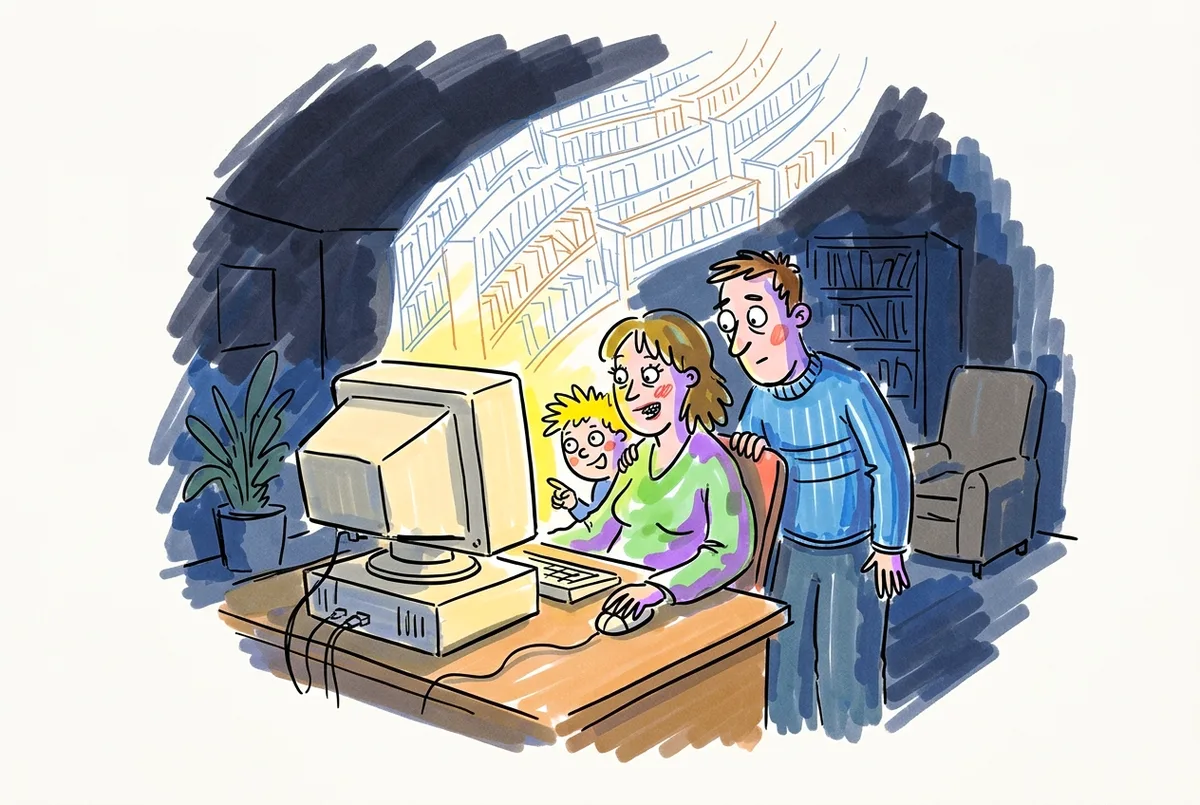
The internet goes mainstream
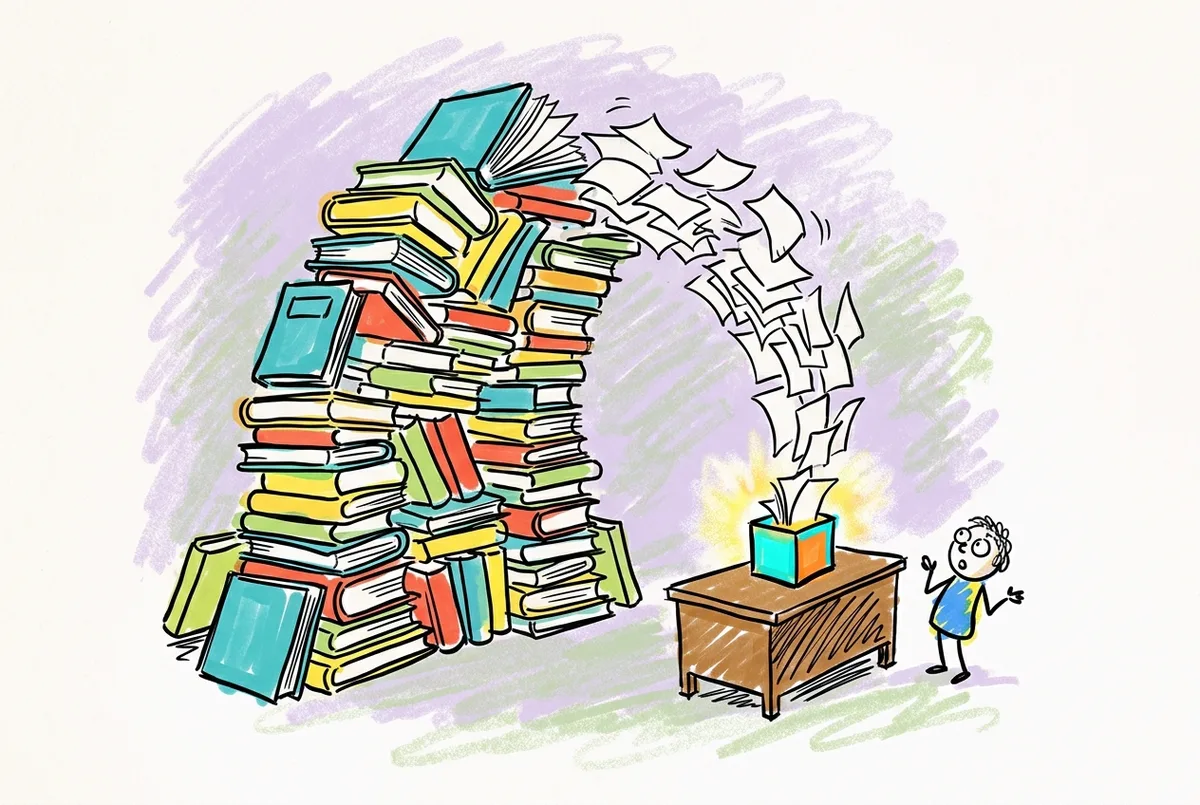
Humanity’s accumulated knowledge moves from libraries and experts to a search box in half the homes of the rich world. For the first time, the constraint on learning almost anything is wanting to, not having access. The next jump of the same kind is further down this page: from looking it up to asking something that has read all of it.
Source: Our World in Data on internet adoption
October 2012
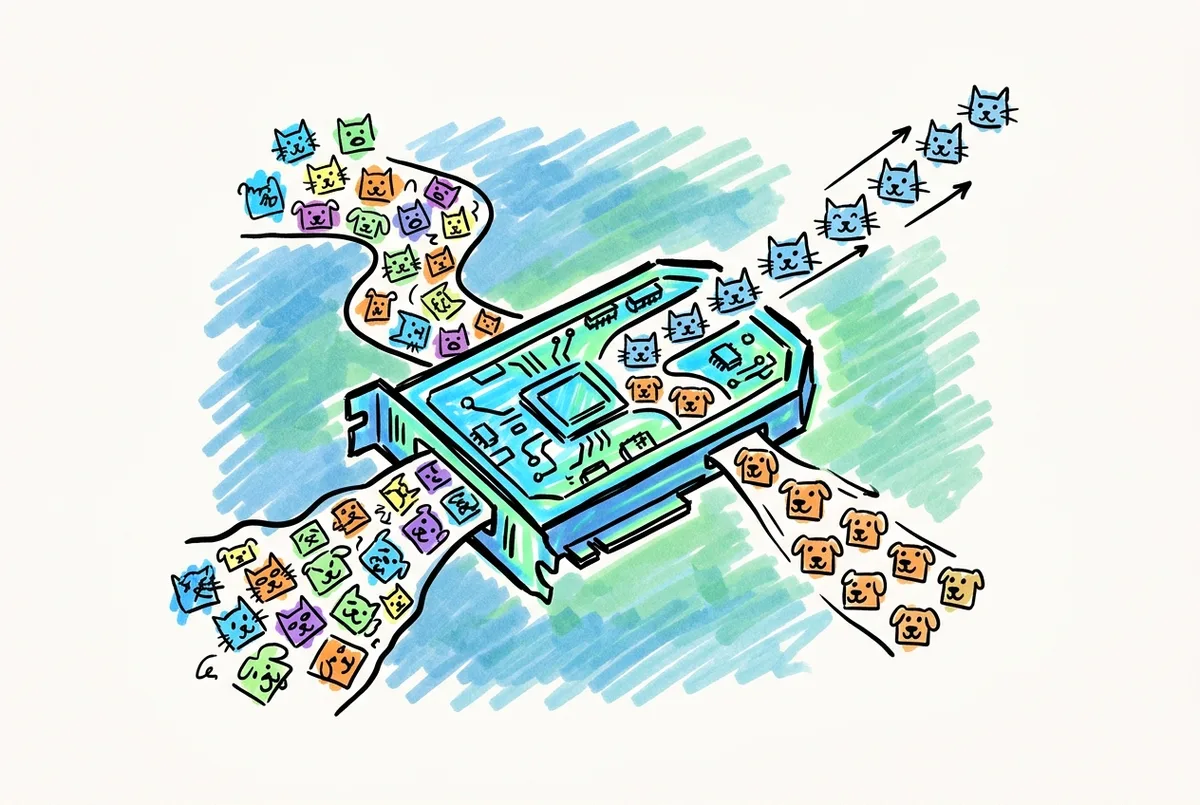
AlexNet
A neural network trained on gaming GPUs halves the error rate on image recognition overnight. Deep learning goes from a stubborn minority position to the entire field in about a year.
Source: the AlexNet paper (NeurIPS 2012)
March 2016
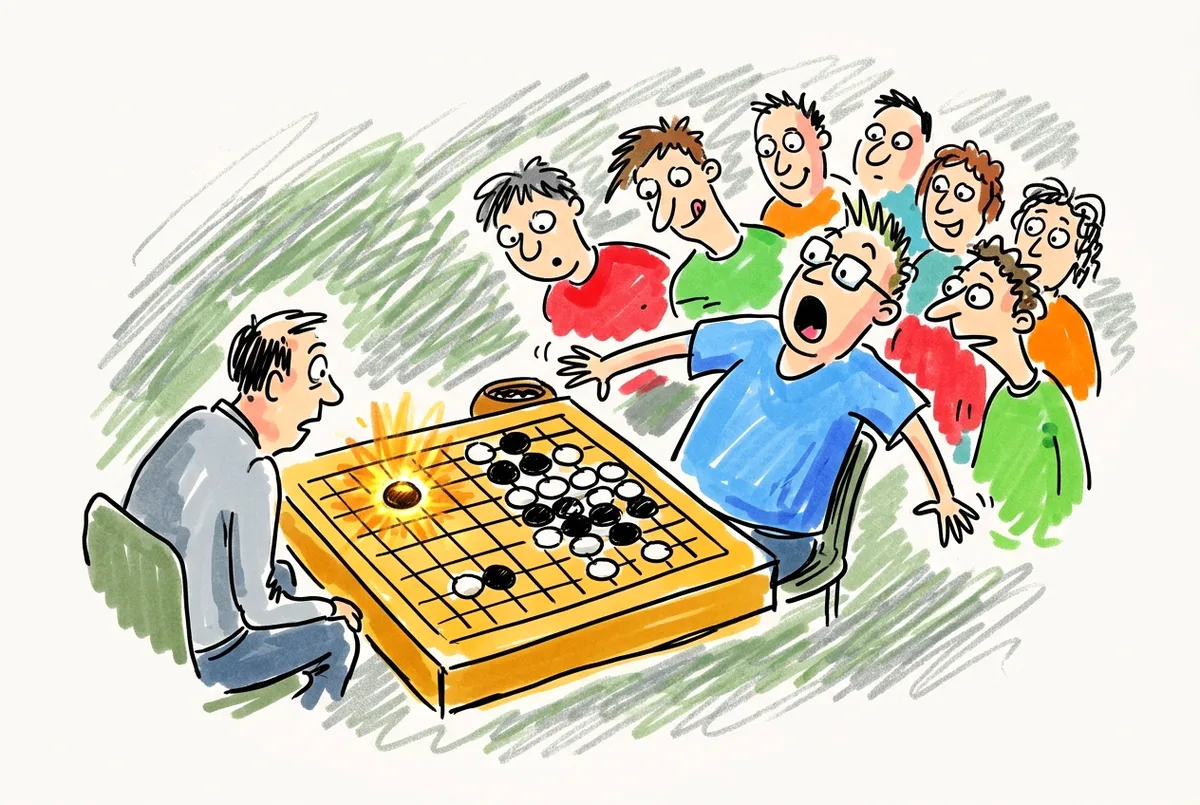
AlphaGo, move 37
A move with a 1-in-10,000 chance of being played by a human turns out to be brilliant. The first mainstream glimpse of machine output that is not imitating us.
Source: Wired's report from the match
June 2017
Transformers
"Attention Is All You Need" describes the architecture behind essentially everything below this card. Eight pages, written as a machine-translation paper.
Source: the paper on arXiv
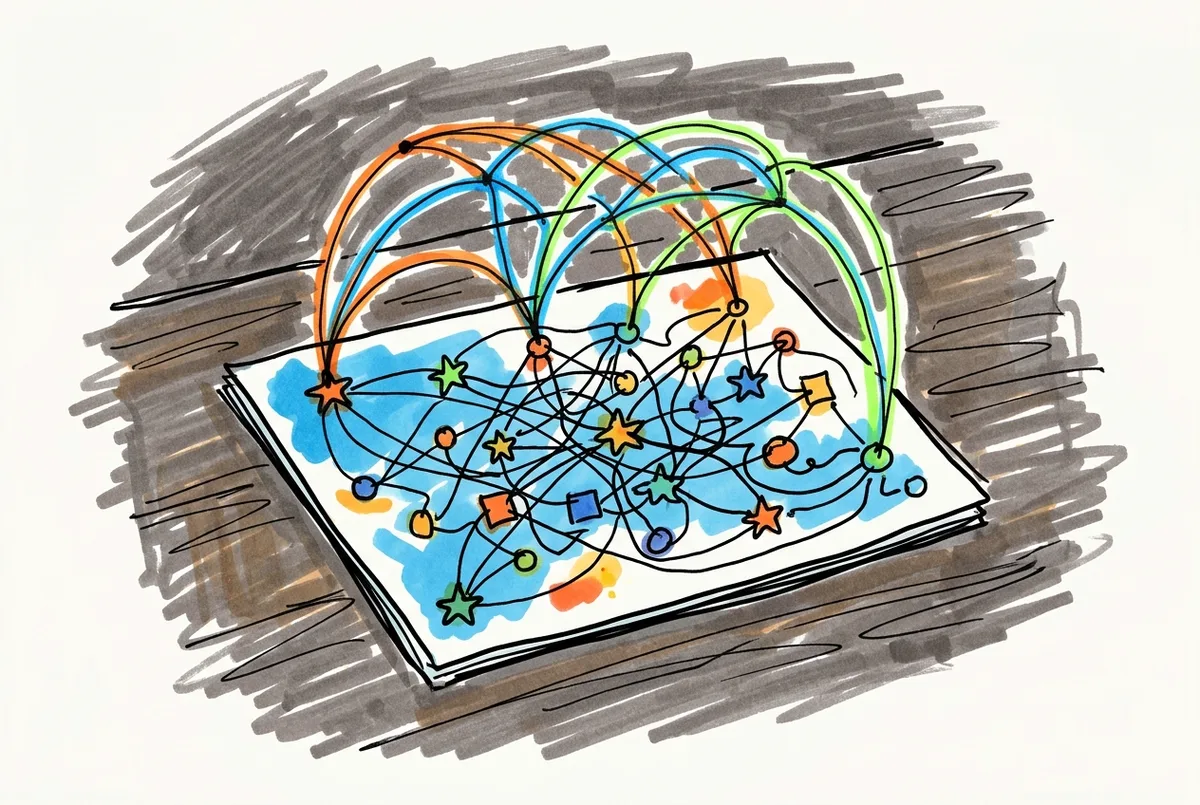
June 2020
GPT-3
Scale alone produces a model that can attempt almost any text task from a description. The scaling-laws bet, that capability is a smooth function of compute, starts paying out in public.
Source: Language Models are Few-Shot Learners
November 2022
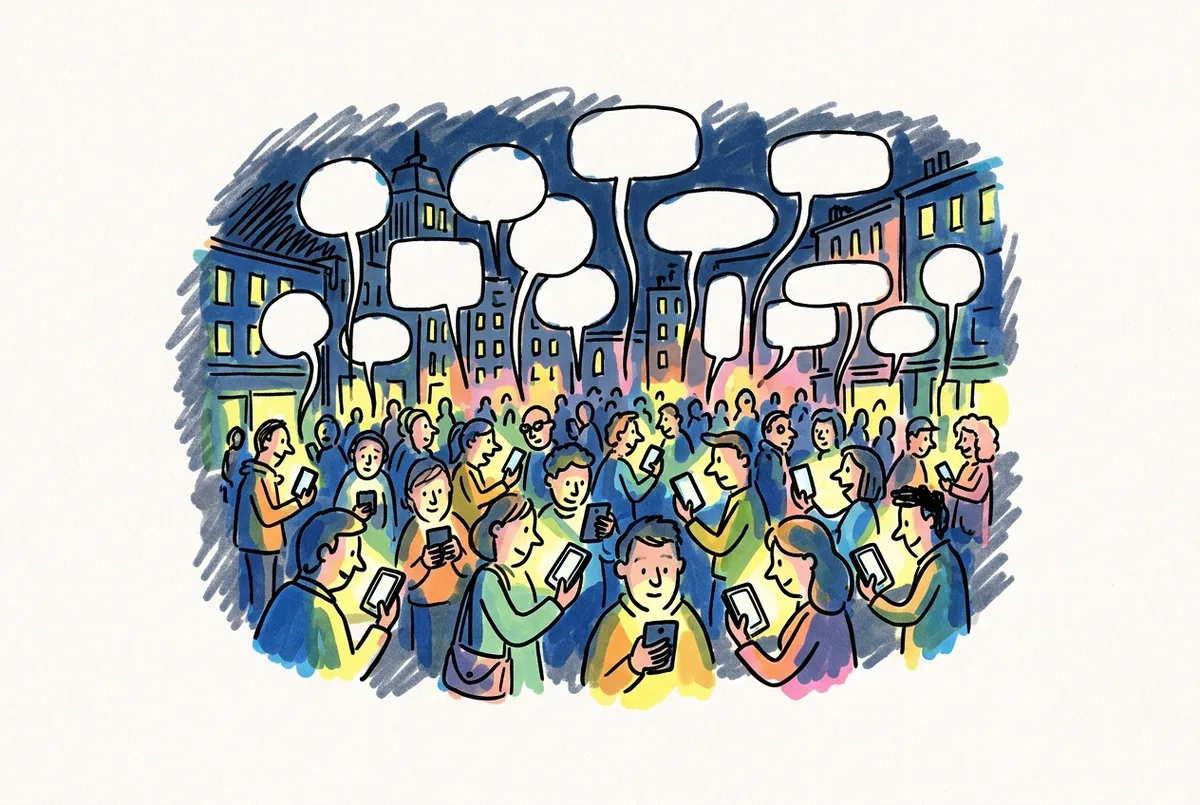
ChatGPT
A chat interface on an existing model reaches 100 million users in two months, the fastest adoption of any consumer product to that point. The capability had existed for years; the moment came from packaging.
Source: Reuters on the adoption record
March 2023
GPT-4
Passes bar exams, reads images, writes working code. The serious version of the argument stops being "can it" and becomes "how far does this go".
Source: OpenAI's GPT-4 announcement
September 2024
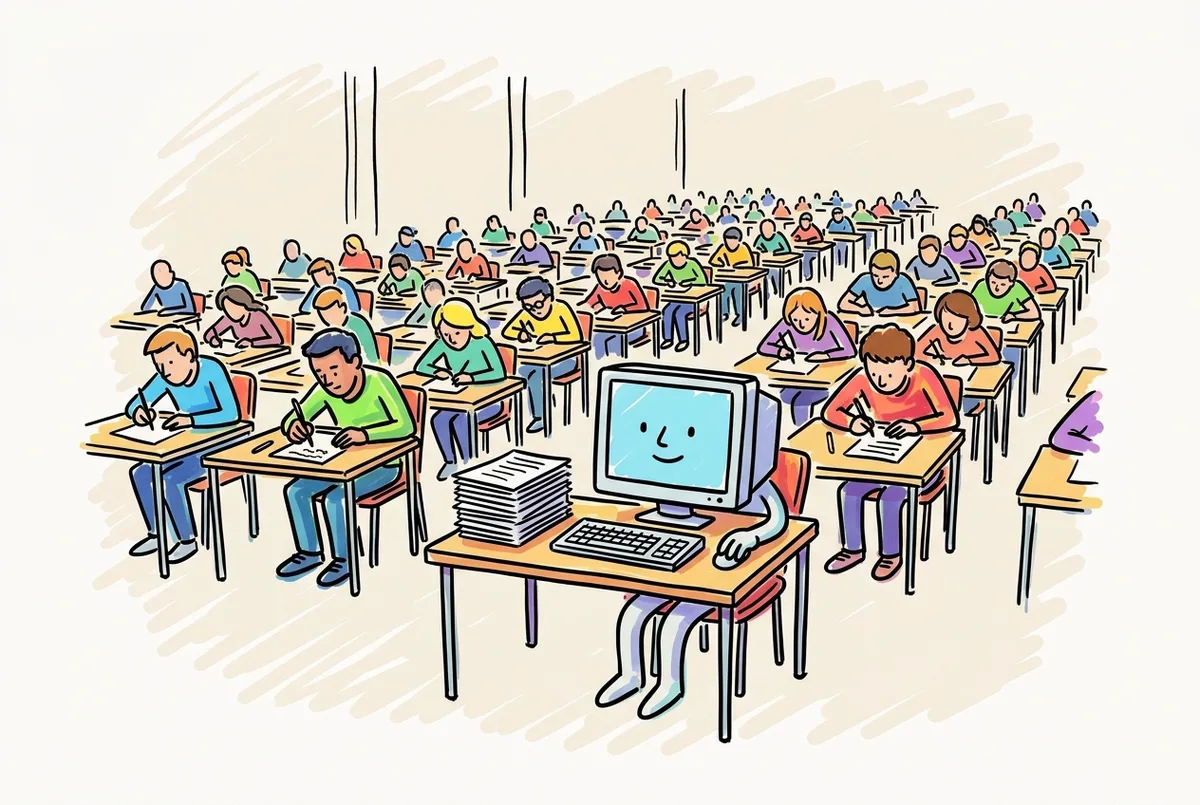
Reasoning models
Models that spend more compute thinking before answering unlock maths and science problems that scaling alone had not. A second axis of improvement opens up next to the first one.
Source: OpenAI's o1 announcement
2025
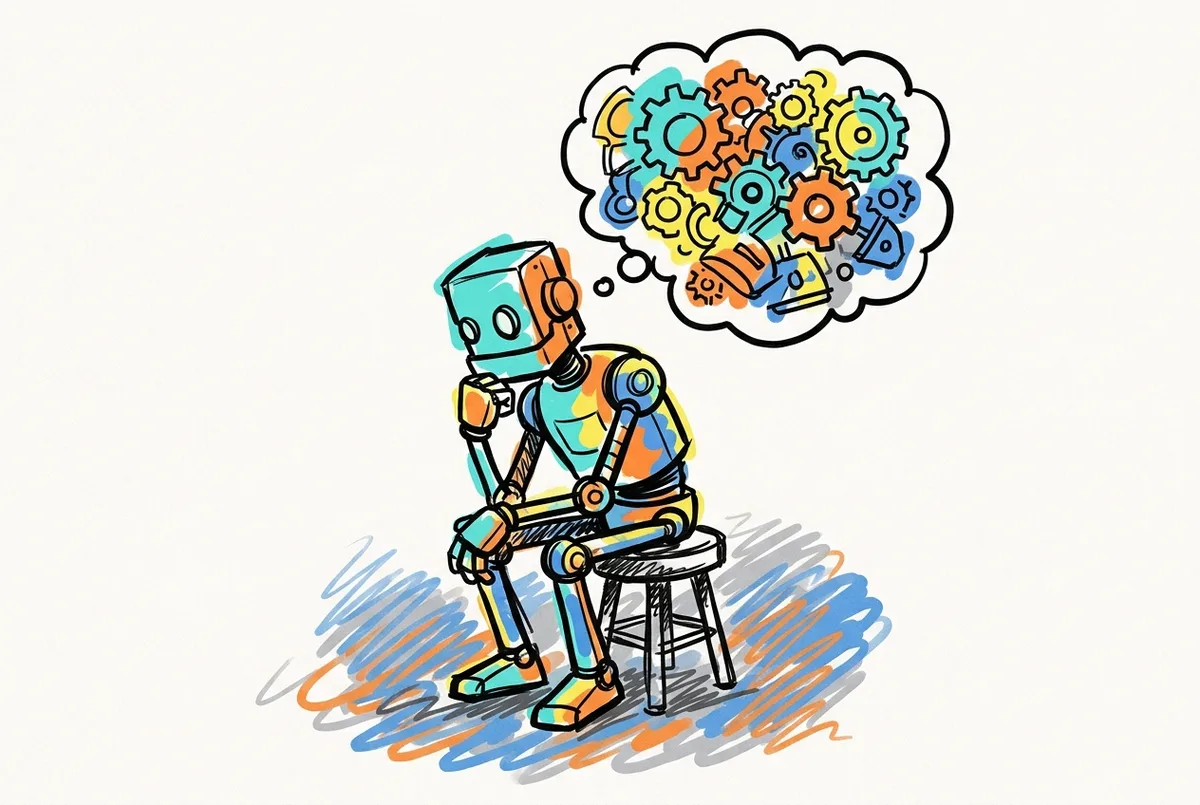
Agents
Models stop just answering and start doing: running tools in loops, writing and testing code for hours unattended, operating computers. The length of task a model can complete on its own has been doubling roughly every seven months.
Source: METR on task-length doubling
Mid 2026
We are here
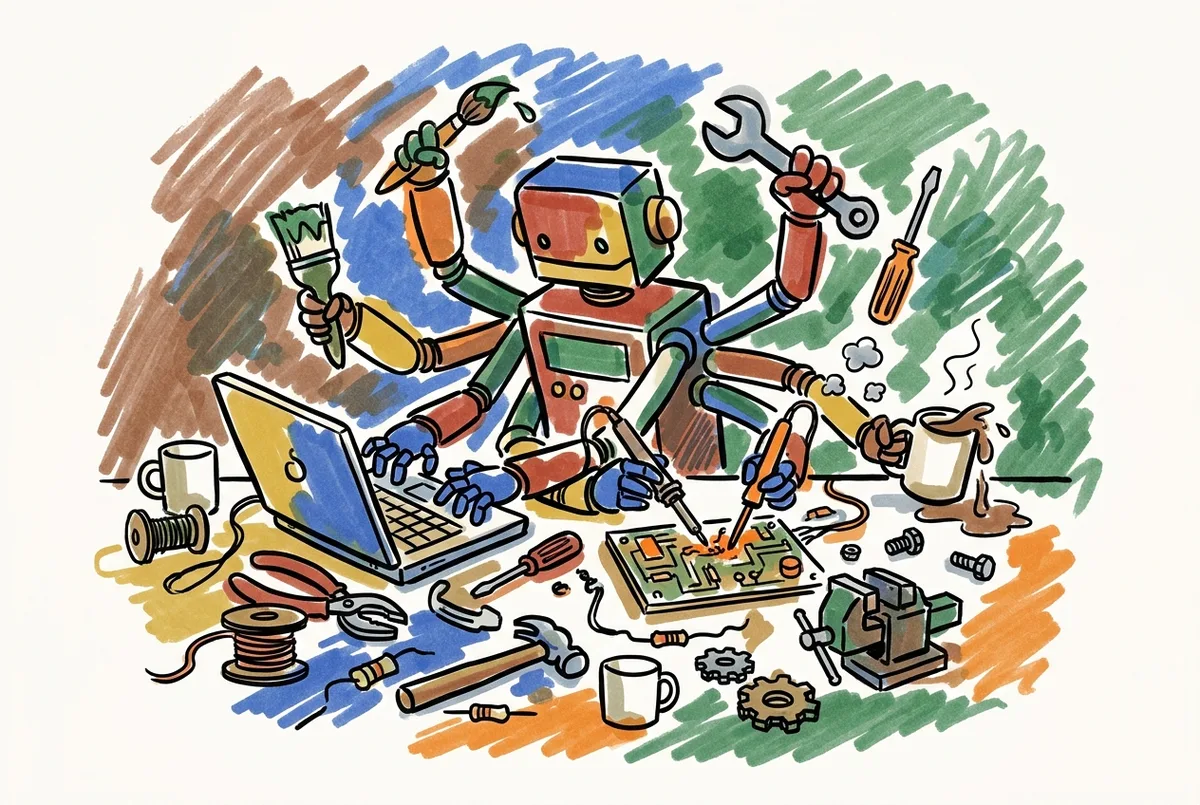
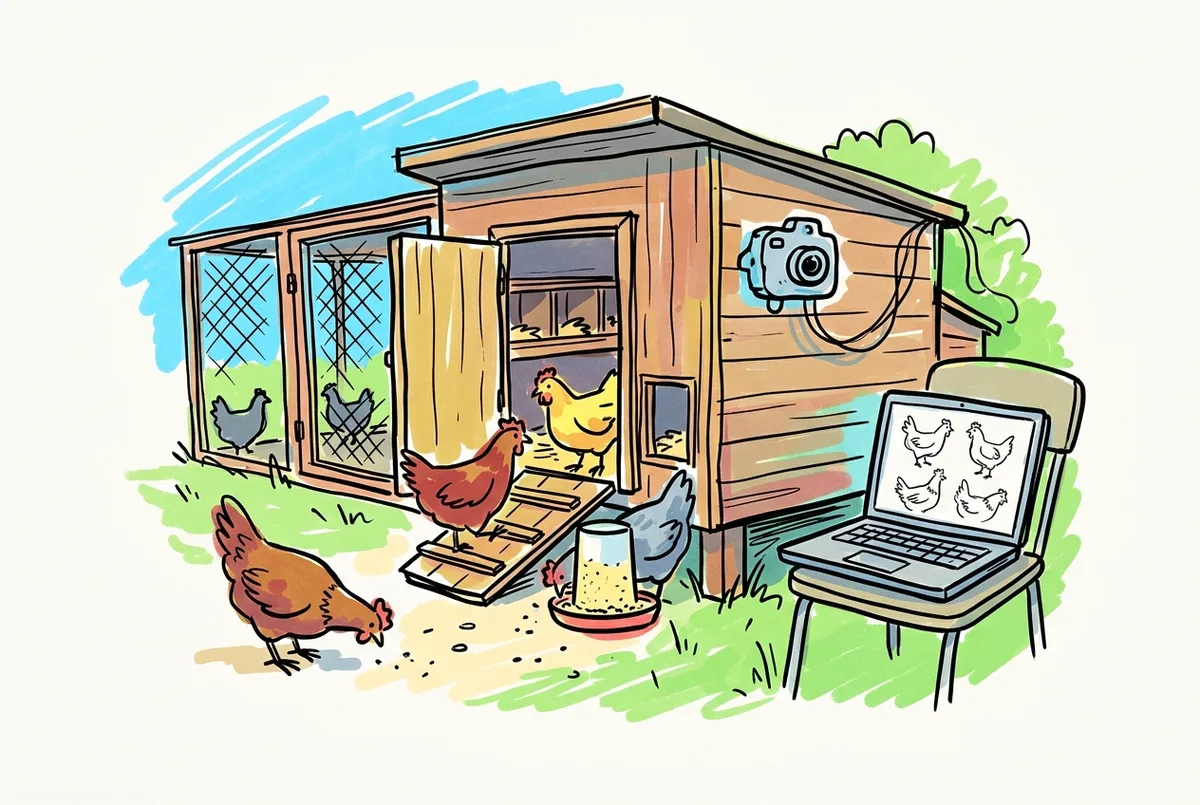
The receipts on this site are from this stretch. An agent on my desk rebuilds its working memory from JSON files every half hour and has kept a journal about individual chickens for months. This page itself was drafted by the model it makes predictions about.
Late 2027 · forecast
The edge crossing
Mid-2025-frontier judgement, 30+ tokens per second, fully offline, on hardware you would carry in a pocket or screw to a coop wall. The moment useful AI stops requiring a round trip to a datacentre and becomes ambient.
Plausible window: 2027 earliest, 2030 latest
Outside consensus (2026): The AI 2027 scenario (Kokotajlo, Alexander et al.) puts superhuman coding agents in 2027 on the same capability curve, but it is a datacentre story; this row bets the other side of the wave, yesterday’s frontier running in your pocket with no round trip. [1]
Mid 2028 · forecast
The robot moment
A humanoid robot holds a normal-paced conversation and then does an unscripted physical task the audience chose, at multiple labs, repeatably, with no teleoperation. The demo that ends the "is it AGI" argument for most people.
Late 2028 · forecast
An AI-credited physics result
A new physics result whose core idea is credited to an AI system and accepted by the field. AI-assisted maths already blurs the edges (proof search, conjecture generation); the bar here is the idea originating with the system, not the grind. Credit assignment may be the real bottleneck: the field has to agree the machine had the idea, and fields are bad at agreeing on credit even among humans.
Plausible window: 2027 earliest, 2035 latest
Outside consensus (2026): Little hard consensus; forecasts are sparse. Some argue it is already partial (a 2026 AI-derived gluon-amplitude result, credit contested); bullish lab leaders say Nobel-level AI science within a couple of years; conservatives say late 2020s to early 2030s. [1] [2]
2029 · forecast
The first fully AI-discovered drug approved
The first drug whose target and molecule were both AI-discovered clears Phase 3 and reaches patients. This one is not oncology: the frontrunner is Insilico’s rentosertib for pulmonary fibrosis, which posted positive Phase 2a lung-function data in Nature Medicine in June 2025 and cut discovery-to-candidate to 18 months. The remaining timeline is mostly trial machinery, which AI barely accelerates yet, so the falsifiable bar is a full approval, not another promising readout.
Plausible window: 2027 earliest, 2033 latest
Outside consensus (2026): 2027 to 2029. Rentosertib is the clear lead: target and compound both AI-designed, Phase 2a done, now in inhaled-formulation trials. Optimists say first approval 2027; normal Phase 3 attrition points to 2028 or 2029. [1] [2] [3]
2030 forecast
The AGI claim that sticks
The first credible AGI claim that survives 30 days of public scrutiny. The honest hedge: the question may dissolve rather than resolve, with capabilities diffusing piecemeal while the goalposts move in both directions at once. The stake post argues mid-2028 for the discourse-ending demo; surviving 30 days of scrutiny as a claim is a higher bar.
Plausible window: 2028 earliest; latest: never, the term dissolves first
Outside consensus (2026): Two camps about 15 years apart. Lab leaders (Amodei, Hassabis, Altman) name a sub-5-year window, 2026 to 2030; the 2023 AI Impacts survey of 2,778 researchers puts 50% odds at 2047. Metaculus median sits around 2031 to 2033. [1] [2] [3]
2030 · forecast
A robot in the home
A humanoid a household can buy does a week of ordinary housework in an unmodified home, no teleoperation, no scripting. Hard mode, because nothing in a home is standardised and everything in it is someone’s irreplaceable stuff. Demos are staged; the falsifiable bar is unmodified homes and a return rate that does not kill the product. Lights-out factories come first. This date bets that hard-takeoff AI closes the manipulation and reliability gap fast; the analyst consensus is slower.
Plausible window: 2028 earliest, 2042 latest
Outside consensus (2026): Early-to-mid 2030s, median around 2032. Company dates of 2026 to 2028 (1X Neo, Optimus) are teleoperated or factory-first, so they do not meet the bar; analysts (Goldman, Morgan Stanley) see consumer ramp only after 2030. [1] [2] [3]
2031 · forecast
An AI-designed cancer drug approved
The harder oncology version of the milestone above: a cancer therapy whose molecule was AI-designed clears trials and reaches patients. Oncology is a separate, slower bet from the fibrosis frontrunner because tumour trials have brutal attrition and long endpoints. DeepMind/Isomorphic put their first AI-designed cancer drugs into Phase 1 in early 2026, with ~15 to 20 AI-originated compounds heading into pivotal trials that year; the falsifiable bar is a tumour drug all the way through approval.
Plausible window: 2029 earliest, 2035 latest
Outside consensus (2026): A few years behind the first non-oncology approval. Analysts put ~60% odds on the first AI-designed drug of any kind clearing approval by 2027, but oncology attrition pushes a cancer-specific approval later. DeepMind/Isomorphic began AI-designed cancer-drug trials in early 2026. [1] [2]
2034 · forecast
A treatment for aging itself
A treatment shown in a large human trial to slow biological aging itself, not one disease at a time. This hinges on regulators accepting aging as an endpoint: the science could land and the milestone still not trigger because nobody agrees what the measurement is. The biomarker fight alone could eat a decade, though AI-run trial design and biomarker discovery are exactly the kind of grind that compresses.
Plausible window: 2030 earliest; latest: never
Outside consensus (2026): 2032 to 2040 and beyond. Longevity advocates (Sinclair "pill by 2035", de Grey) sit around 2035; mainstream gerontology, the TAME trial camp, says late 2030s. The real gate is regulatory: the FDA has not accepted aging as an endpoint. [1] [2] [3]
2035 · forecast
Verified superhuman breadth
A system produces verified results the best specialists could not have produced, in several unrelated fields at once. One field is a tool. Several at once is something else. "Smarter than any human at everything" is unfalsifiable, so this row tracks the observable version: output the field can verify but could not have generated, across domains too different for it to be one trick.
Plausible window: 2030 earliest; latest: never
Outside consensus (2026): 2028 to 2040-plus, or never. Lab insiders (Altman, Amodei, the AI Futures model) cluster 2027 to 2030; skeptics (LeCun, broad surveys) say 2040-plus, or that a missing architecture means never. [1] [2]
2040 · forecast
An uplifted animal
A deliberately cognitively enhanced animal demonstrates open-ended symbolic communication under controlled conditions. The milestone most gated by choice rather than capability: ethics boards set this date, not labs. The tools will likely exist well before anyone is permitted to use them, which makes the gap between "could" and "did" the interesting measurement.
Plausible window: 2035 earliest; latest: never
Outside consensus (2026): No forecast exists. No prediction market or survey tracks this; the discussion is bioethics, not timelines. It is ethics-gated, not capability-gated. [1] [2]
2044 · forecast
A mammal brain, emulated
A complete functional emulation of a mammalian brain, behaviour matching the original animal. Human upload is not the milestone; the mouse is, and the mouse is brutally hard. The connectome is necessary but nowhere near sufficient (synaptic weights, neuromodulator state, body coupling). The bet on this date rather than mid-century is that AI collapses the modelling and inference bottlenecks; the older forecasts assumed unaided human science all the way down.
Plausible window: 2040 earliest; latest: never
Outside consensus (2026): No firm year for the mammal. The nearest tracked number is human upload: Metaculus median around 2070, range 2050 to never. Even C. elegans, 302 neurons and mapped since 1986, is not behaviourally emulated yet. [1] [2] [3]